
Intel Sanitizer on Aurora
Introduction
Intel Sanitizer is a correctness tool to detect addressability issues, memory leaks, data races and deadlocks, and use of uninitialized memory. With the addition of the sanitizer compiler flags, a sanitizer device image is created. At runtime, the sanitized images are checked. If they exist, the runtime enables a specific sanitizer layer in the unified runtime module to support sanitizer functionality.
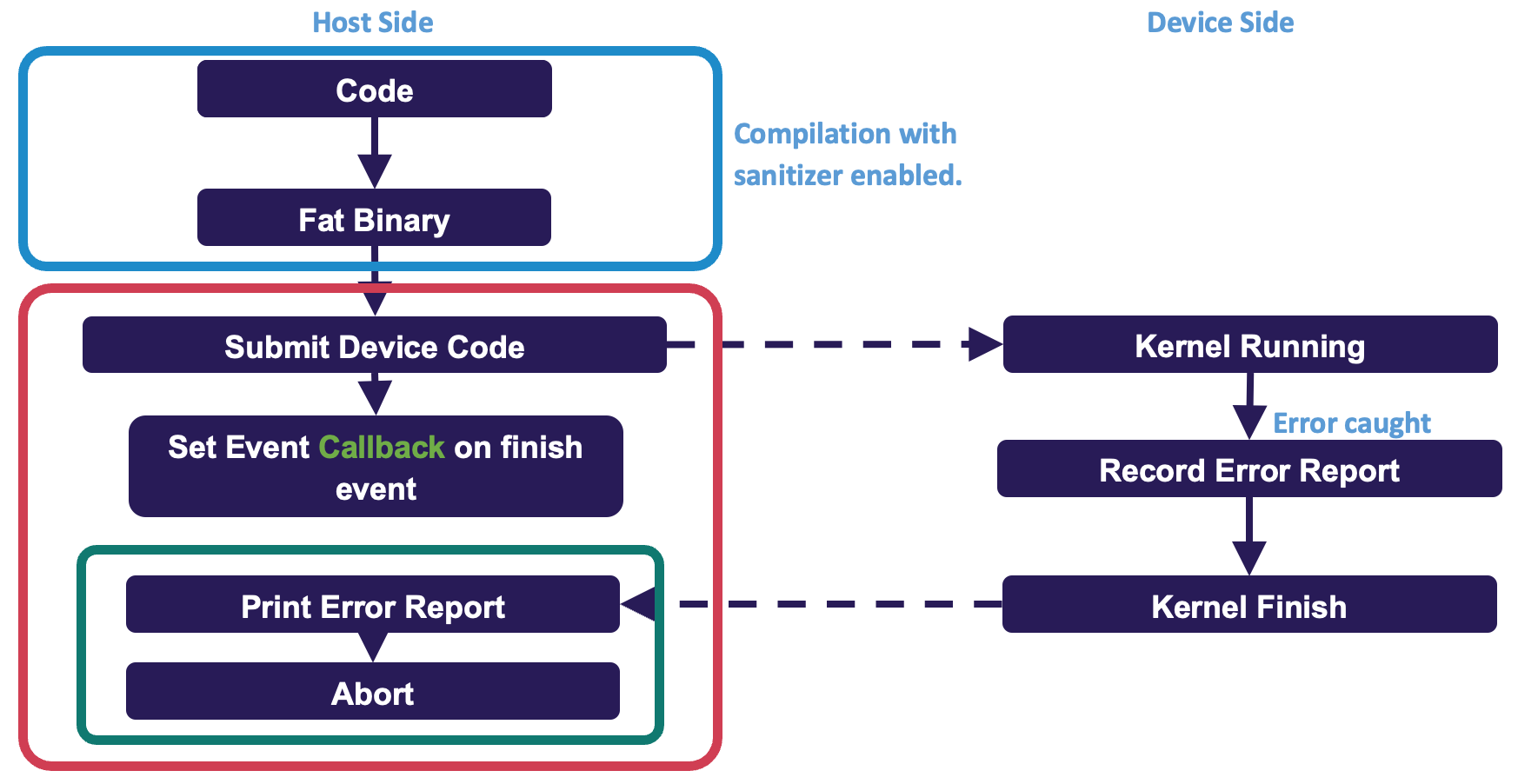
Address, Memory, and Thread Sanitizers are provided with the oneAPI compiler for device codes on Aurora with the following features:
- Address Sanitizer (ASAN)
- Out-of-bound check
- Use-after-free
- Misaligned access
- Mismatched deallocation
- Misusing host & device pointers
- Invalid kernel argument
- Mismatched queue
- Memory Sanitizer (MSAN)
- Use of uninitialized memory
- Thread Sanitizer (TSAN)
- Deadlock
- Data race
Building and running instruction with Sanitizers
Address Sanitizer (ASAN)
-
Enabling device-side ASAN on a SYCL kernel
-
Enabling device-side ASAN on OpenMP code (with
icx,icpxorifx) -
An error message example (e.g., OpenMP Fortran example)
==== DeviceSanitizer: ASAN
…
====ERROR: DeviceSanitizer: out-of-bounds-access on Device USM (0xff00fffff4a00280)
WRITE of size 8 at kernel <__omp_offloading_10301_140c146_gpu_rhf_j01_ssss__l85> LID(163, 0, 0) GID(12707, 0, 0)
#0 OMP TARGET outline from gpu_rhf_j01_ssss_ line 85 /tmp/debug-bench/applications/GAMESS/build/Release/object/tgpu_ompmod_sp.F90:106
Memory Sanitizer (MSAN)
-
Enabling device-side MSAN on a SYCL kernel
-
Enabling device-side MSAN on OpenMP code (with
icx,icpxorifx) -
An error message example (e.g., OpenMP C++ example)
==== DeviceSanitizer: MSAN
…
====WARNING: DeviceSanitizer: use-of-uninitialized-value
use of size 1 at kernel <__omp_offloading_10301_12070fb__ZN6openmc19process_init_eventsEi_l178> LID(0, 0, 0) GID(3648, 0, 0)
#0 OMP TARGET outline from openmc::process_init_events(int) line 178 /localdisk2/maosuzha/ics_workspace/debug-bench/applications/OpenMC/src/src/event.cpp:180
Thread Sanitizer (TSAN)
-
Enabling device-side TSAN on a SYCL kernel
-
Enabling device-side TSAN on OpenMP code (with
icx,icpxorifx) -
An error message example (e.g., SYCL example)
==== DeviceSanitizer: TSAN
…
====WARNING: DeviceSanitizer: data race
When write of size 1 at 0xff00fffffffe0000 in kernel <typeinfo name for main::{lambda(sycl::_V1::handler&)#1}::operator()(sycl::_V1::handler&) const::Test> LID(7, 0, 0) GID(23, 0, 0)
  #0 typeinfo name for main::'lambda'(sycl::_V1::handler&)::operator()(sycl::_V1::handler&) const::Test /tmp/demo.cpp:10
Notes
- For CPU-side sanitizers, you can build your code with
-Xarch_hostinstead of-Xarch_device. - To enable memory sanitizer origin tracking, you can use
-fsanitize-memory-track-origins=1.
Known issues and workarounds
No DEEPBIND support from host-side sanitizers
The host-side sanitizer does not support DEEPBIND. You will get errors like the following:
==104942==You are trying to dlopen a libigc.so.2 shared library with RTLD_DEEPBIND flag which is incompatible with sanitizer runtime (see https://github.com/google/sanitizers/issues/611 for details). If you want to run libigc.so.2 library under sanitizers please remove RTLD_DEEPBIND from dlopen flags.
dlopen other libraries with the following environemental variables: export ASAN_OPTIONS=clear_deepbind_flag=1 // for address sanitizer
export MSAN_OPTIONS=clear_deepbind_flag=1 // for Memory sanitizer
export TSAN_OPTIONS=clear_deepbind_flag=1 // for thread sanitizer
SEGV on multi-node runs with ASAN on the host
When a code is compiled with "-Xarch_host -fsanitize=address" to turn on address sanitizer on the device, there may be a SEGV as below:
> mpicxx -Xarch_host -fsanitize=address -fsycl -g sycl.cpp
> mpirun -n 2 -ppn 1 ./a.out
==111900==ERROR: AddressSanitizer: SEGV on unknown address 0x0000000898ce (pc 0x0000000898ce bp 0x000000000000 sp 0x7ffc1a1e1f38 T0)
This is due to a conflict of libfabric's memory monitor memhook (the default) and asan both intercepting mmap in incompatible ways, resulting in ASAN segfaulting. A workaround for this is to change the Libfabric memory monitor and set: export FI_MR_CACHE_MONITOR=userfaultfd. See more details here: https://github.com/argonne-lcf/AuroraBugTracking/issues/141